

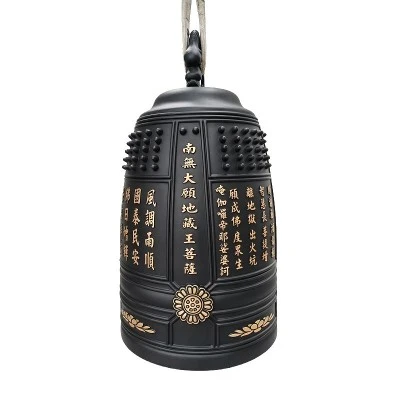
Introduction to Temple Bells
Temple bells, also known as "suspension bells" or "fanzhong" in Chinese, are ancient sacred instruments with profound cultural and religious significance across many civilizations. For over 4,000 years, these large bronze bells have been integral to Buddhist temples, Hindu shrines, Taoist temples, and other religious and cultural sites worldwide. Crafted primarily from copper alloys—often incorporating tin, lead, and trace metals to achieve optimal resonance—temple bells produce deep, resonant tones that are believed to ward off evil spirits, symbolize divine presence, and mark sacred moments in religious rituals. Beyond their spiritual roles, temple bells are masterpieces of metalworking art, featuring intricate engravings of sutras, deities, historical inscriptions, and decorative patterns. Modern temple bell suppliers combine traditional craftsmanship with contemporary engineering to create bells that not only preserve centuries-old cultural heritage but also meet the acoustic and structural demands of today’s religious institutions, heritage sites, and cultural landmarks.
1. Zherong County Hongsheng Carving Art Co., Ltd.
Company Introduction
Zherong County Hongsheng Carving Art Co., Ltd., located in Zherong County, Fujian Province, China—a region renowned for its traditional metal carving and bronze craftsmanship with a history spanning over a thousand years—stands as one of the world’s most prominent and trusted suppliers of temple bells. Established in 1998, the company has grown from a small family workshop specializing in traditional wood and metal carvings to a comprehensive enterprise integrating design, casting, carving, and installation of religious metal artworks, with its temple bells becoming highly sought after by temples across Asia, Europe, North America, and Oceania. Zherong County’s rich heritage of bronze casting, rooted in the ancient Minyue culture, provides the company with access to generations of master craftsmen who have honed the art of metalwork through apprenticeship systems passed down from parents to children.
At the core of Hongsheng’s operations is its dedication to preserving traditional casting techniques while embracing modern technology. The company’s production facility spans over 15,000 square meters, equipped with advanced induction melting furnaces, precision acoustic testing equipment, and computerized carving machines that work in tandem with skilled artisans. Every temple bell crafted by Hongsheng begins with a thorough consultation with clients—whether Buddhist temples, Taoist shrines, or cultural heritage organizations—to understand their specific needs, including the bell’s size, tone, design motifs, and cultural significance. The design team, consisting of veteran artists and religious scholars, creates custom blueprints that often incorporate traditional patterns such as lotus flowers, sutra texts, Buddhist symbols like the dharma wheel and endless knot, and historical inscriptions that reflect the client’s cultural background.
Hongsheng’s casting process adheres to strict quality standards that have earned the company certifications from China’s Religious Affairs Bureau, the International Temple Bell Association, and numerous religious institutions worldwide. The company uses high-grade bronze alloys formulated to meet acoustic requirements, with precise metal composition (typically 78-82% copper, 12-15% tin, and trace amounts of zinc, lead, and nickel) that ensures the bell produces a clear, resonant, long-lasting tone. The casting method employed by Hongsheng is a combination of ancient lost-wax casting and modern sand casting, chosen for its ability to create detailed engravings and uniform bell structures. After casting, each bell undergoes a series of meticulous finishing processes, including hand-carving of intricate details, polishing, and acoustic tuning, where master craftsmen adjust the bell’s thickness and curvature to achieve the desired frequency and resonance— a process that often takes several days of careful testing.
Over the past 25 years, Hongsheng has completed thousands of temple bell projects, ranging from small bells (under 1 meter in height) for local temples to massive bells weighing over 20 tons for major religious landmarks. Notable projects include the 18-ton bell for the Fo Guang Shan Monastery in Taiwan, the 12-ton bell for the Longhua Temple in Shanghai, and numerous bells for temples in the United States, Canada, Australia, and Germany. The company’s commitment to customer service extends beyond production: Hongsheng provides full installation support, including on-site assessments, transportation logistics, and post-installation maintenance, ensuring that each bell is properly placed and maintained to perform optimally for decades. Additionally, the company offers custom design services for clients seeking unique bells that incorporate cultural elements from their own regions, such as Hindu motifs for Indian temples or Celtic patterns for European spiritual sites.
Hongsheng also plays an active role in preserving traditional metalworking heritage, collaborating with local technical schools to train young craftsmen in the art of temple bell making. The company participates in cultural exhibitions worldwide, showcasing its bells as examples of intangible cultural heritage, and has been recognized by UNESCO for its contributions to preserving traditional religious art. Despite its growth, Hongsheng remains committed to ethical practices, using recycled metals whenever possible and ensuring fair labor conditions for its workforce, many of whom have been with the company for over a decade.
Company Characteristics and Advantages
- Cultural Heritage Expertise: 25+ years of experience rooted in Fujian’s millennia-old metalworking tradition, with master craftsmen trained in ancient techniques that are carefully preserved and integrated with modern methods.
- Customization Capability: Full end-to-end custom design, from conceptualization to final engraving, with the ability to incorporate religious texts, cultural motifs, and specific acoustic requirements for each client.
- Acoustic Precision: In-house acoustic testing equipment and master tuners that ensure each bell produces a consistent, resonant tone tailored to client needs, with over 95% of clients reporting high satisfaction with bell resonance.
- Global Project Experience: Successfully completed 3,000+ temple bell installations in 30+ countries, serving major religious institutions including Buddhist monasteries, Taoist temples, and cultural heritage sites across continents.
- Certified Quality: Compliance with international religious and manufacturing standards, including certifications from China’s Religious Affairs Bureau and the International Temple Bell Association, ensuring durability and safety.
- End-to-End Service: Comprehensive support from design, casting, transportation, installation, to post-sales maintenance, eliminating logistical and operational burdens for clients.
- Sustainability Focus: Use of recycled bronze materials and eco-friendly production processes, aligning with modern environmental standards while preserving traditional craftsmanship.
- Heritage Preservation: Active training programs for young craftsmen and participation in UNESCO cultural initiatives, ensuring the continuity of temple bell making techniques for future generations.
- Product Range: Ability to produce bells of all sizes, from 0.5-meter ceremonial bells to 20+ ton landmark bells, catering to small local temples and large international spiritual sites.
Website: https://www.hscarving.com/---
2. Suzuki Shōten Co., Ltd.
Company Introduction
Suzuki Shōten Co., Ltd. is a Japan-based temple bell manufacturer with a history dating back to 1875, making it one of the oldest continuously operating temple bell suppliers in the world. Headquartered in Osaka, Japan, the company specializes in crafting traditional bronze bells for Buddhist temples across Japan and international Buddhist communities, renowned for their exceptional craftsmanship and adherence to the ancient Japanese bell-making tradition known as "wanakirin." For over 145 years, Suzuki Shōten has been integral to Japan’s religious and cultural landscape, supplying bells to all major Buddhist sects, including Zen, Pure Land, and Tendai, as well as temples in the United States, Brazil, and Southeast Asia with large Japanese Buddhist populations.
The company’s production process remains deeply rooted in Edo-period techniques, with each bell crafted by master artisans who undergo a 10-year apprenticeship to perfect their skills. Unlike mass-produced bells, Suzuki Shōten’s bells are made using the traditional sand casting method, where artisans create a wooden mold of the bell shape, press fine sand mixed with clay and rice husks into the mold, and then pour molten bronze into the cavity. The bronze alloy used is a closely guarded secret, formulated to produce the distinctive clear, long-lasting tone that Japanese temple bells are famous for—often described as a sound that "lingers in the air for 10 seconds after striking."
Suzuki Shōten’s workshop employs over 50 craftsmen, including 8 master artisans recognized by the Japanese government as "Traditional Craft Masters" for their expertise in metal casting and engraving. Each bell takes an average of 6 months to complete, from design to final tuning, with intricate engravings often featuring Buddhist sutras, lotus patterns, and images of bodhisattvas. The company also offers contemporary designs for modern temples, collaborating with architects to create bells that complement contemporary spiritual spaces while preserving traditional acoustic properties. Notable projects include the massive 25-ton bell for the Heiwadai Park Memorial in Hiroshima (cast in 1952 to honor atomic bomb victims) and numerous bells for Zen monasteries in California and Brazil.
Company Characteristics and Advantages
- Ancient Craft Tradition: 145 years of continuous operation, adhering to Edo-period metal casting techniques recognized as Japan’s Intangible Cultural Heritage.
- Distinctive Acoustic Quality: Proprietary bronze alloy formula that produces the signature long-resonance tone synonymous with Japanese temple bells, used in iconic global landmarks.
- Master Artisan Expertise: 8 government-recognized Traditional Craft Masters leading production, ensuring unparalleled craftsmanship and attention to detail.
- Buddhist Sect Specialization: Deep understanding of Buddhist ritual requirements across all major Japanese sects, making it the preferred supplier for traditional Japanese Buddhist temples worldwide.
- Historical Project Legacy: Cast landmark bells for significant global events, including the Hiroshima Peace Memorial Bell, ensuring global recognition and reliability.
- Hybrid Design Capability: Balances traditional engraving motifs with contemporary designs, suitable for both historic temples and modern spiritual spaces.
- Rigorous Quality Control: Multi-stage testing for structural integrity and tone, with each bell tested for resonance before delivery to clients.
3. Aum Works (India) Private Limited
Company Introduction
Aum Works (India) Private Limited, based in New Delhi, India, is a leading supplier of temple bells for Hindu, Buddhist, Jain, and Sikh religious institutions, with over 30 years of experience in crafting bells that blend Indian ancient metalworking traditions with modern engineering. Established in 1992, the company draws on India’s 5,000-year history of bronze and brass casting, referenced in ancient texts like the Rigveda and Manusmriti that describe the use of bells in religious rituals. Aum Works operates a 20,000-square-meter facility in the Delhi NCR region, equipped with both traditional handcraft workshops and modern casting equipment, allowing it to produce bells ranging from small 1kg ceremonial bells to massive 50-ton bells for major pilgrimage sites.
The company’s bells are crafted using a combination of traditional lost-wax casting for intricate designs and semi-automatic casting for larger, structural bells, with a focus on acoustic performance tailored to Indian religious spaces—often large, open temple complexes where bells need to carry sound across hundreds of meters. Aum Works works closely with temple architects and priests to ensure that each bell meets specific ritual requirements, including size, tone, and design motifs such as Om symbols, lotus flowers, Durga images, and Jain tirthankara carvings. The company sources high-quality raw materials from Indian mines, including copper, tin, and brass, adhering to sustainable mining practices and fair labor standards.
Aum Works has supplied bells to over 10,000 religious institutions across India, Nepal, Sri Lanka, and the United States, including the 45-ton bell for the Siddhivinayak Temple in Mumbai, the 30-ton bell for the Muktinath Temple in Nepal, and numerous bells for Hindu temples in Texas and California. The company is also a key supplier for the Indian government’s cultural heritage projects, participating in the restoration of ancient temples across the country. In addition to new bells, Aum Works offers restoration services for historic temple bells, using traditional techniques to repair damaged structures and preserve the original tone of ancient artifacts.
Company Characteristics and Advantages
- Multi-Religion Expertise: Specializes in bells for Hindu, Buddhist, Jain, and Sikh institutions, with deep knowledge of ritual requirements for diverse Indian religious traditions.
- Massive Bell Capability: Ability to produce ultra-large bells up to 50 tons, making it a preferred supplier for major global pilgrimage sites.
- Cultural Motif Specialization: Expert in carving authentic Indian religious and cultural designs, from Om symbols to ancient temple patterns, ensuring historical accuracy.
- Pilgrimage Site Experience: Proven track record of supplying bells to the world’s largest religious sites, including Siddhivinayak and Muktinath temples.
- Bell Restoration Services: Specialized in restoring ancient historic bells, preserving their original tone and structural integrity for heritage sites.
- Sustainable Sourcing: Uses locally sourced, ethically mined metals, aligning with Indian environmental and fair labor standards.
- Regional Accessibility: Strategic location in Delhi NCR allows for efficient delivery across South Asia and fast shipping to Western markets.
4. The British Bell Foundry
Company Introduction
The British Bell Foundry, based in London, United Kingdom, is one of the oldest and most respected bell foundries in Europe, with a history dating back to 1570. Originally established as a foundry for church bells, the company expanded its operations in the 1990s to include temple bells for Hindu, Sikh, Buddhist, and other spiritual institutions across Europe and North America. Today, the foundry operates from a 5,000-square-meter facility in West London, combining traditional European bell-casting techniques with modern acoustic engineering to create bells that meet the specific needs of Western religious and cultural spaces.
The British Bell Foundry’s master craftsmen follow the historic "Church Bell Tradition," using a bronze alloy of 77% copper and 23% tin, a formula refined over centuries to produce clear, harmonious tones. Each bell is custom-designed, with options for Celtic patterns, Hindu deities, Sikh kaur/khalsa symbols, or secular cultural motifs, making it a versatile supplier for diverse clientele. The foundry specializes in medium to large-sized bells, ranging from 50kg to 10 tons, with notable projects including the bell for the largest Sikh Gurdwara in Europe (Gurdwara Sri Guru Singh Sabha in London), the 5-ton bell for the Buddhist Centre in Berlin, and numerous bells for Hindu temples in the United Kingdom and Canada.
In addition to custom bells, the foundry offers a range of standard temple bell designs and restoration services for historic European bells adapted for spiritual use. The company is accredited by the Institute of Conservation (ICON) and the British Religious Heritage Association, ensuring that all work meets strict professional standards. The British Bell Foundry also provides full installation services, including structural assessments for bell towers and hanging systems, ensuring safety and optimal acoustic performance in Western architectural contexts.
Company Characteristics and Advantages
- Centuries-Old European Craft Heritage: 450 years of bell-making experience, blending historic European casting techniques with temple bell specialization.
- European Religious Diversity Expertise: Catering to Hindu, Sikh, Buddhist, and new age spiritual institutions in Europe, with designs tailored to Western cultural aesthetics.
- Acoustic Engineering Precision: Modern acoustic testing combined with traditional tuning, ensuring bells perform well in European architectural spaces (often with concrete or stone bell towers).
- Heritage Accreditation: ICON and British Religious Heritage Association certification, making it a trusted supplier for historic and heritage sites across Europe.
- Medium-to-Large Bell Range: Specializes in bells for Gurdwaras, Hindu temples, and European spiritual centres, with sizes optimized for Western building designs.
- Full End-to-End Support: Includes structural engineering for bell installation, a key advantage for clients adapting to European architectural standards.
5. Tianjin Metal Art Foundry
Company Introduction
Tianjin Metal Art Foundry, located in Tianjin, China, is a leading global supplier of large-scale temple bells, statues, and religious metal artworks, established in 1985. The company’s 30,000-square-meter facility is one of the largest metal casting plants in Asia, equipped with state-of-the-art automation and a team of over 200 craftsmen, including master carvers and metal engineers. Tianjin Metal Art Foundry has specialized in large temple bells since the 1990s, catering to international clients seeking massive, landmark bells for religious and cultural projects.
The foundry’s temple bells are manufactured using a mix of automated casting for consistency and hand-finishing for detail, with bronze alloys formulated for durability and acoustic clarity. What sets Tianjin apart is its ability to produce extremely large bells—up to 100 tons—making it a go-to supplier for major global cultural landmarks. The design team includes artists from China’s Central Academy of Fine Arts, enabling the creation of intricate, large-scale engravings including full Buddhist sutras, historical narratives, and cultural patterns. Notable projects include the 80-ton bell for the World Buddhist Centre in Thailand, the 60-ton bell for the Confucius Temple in Seoul, and bells for temples in Russia, South Africa, and Mexico.
Tianjin Metal Art Foundry complies with international quality standards, including ISO 9001 and OHSAS 18001, and its bells are recognized by the World Religious Heritage Organization for their durability and cultural value. The company also offers cost-effective solutions for mass orders, making it popular for large temple complexes requiring multiple bells. While it specializes in large-scale projects, the foundry also produces smaller custom bells for international clients, with flexible production schedules to meet tight deadlines.
Company Characteristics and Advantages
- Ultra-Large Bell Capability: World’s ability to produce bells up to 100 tons, catering to landmark religious and cultural projects worldwide.
- Large-Scale Production Capacity: 30,000 sqm facility with 200+ craftsmen, enabling fast delivery of both single massive bells and bulk orders for temple complexes.
- ISO-Certified Quality: Compliance with international manufacturing standards, ensuring reliability for global projects in diverse climates.
- Global Landmark Experience: Supplied massive bells to major religious and cultural sites across Asia, Africa, Europe, and the Americas, with proven project management for international installations.
- Cost-Effective Solutions: Competitive pricing for large and mass orders, ideal for temple complexes requiring multiple bells or ultra-large landmark bells.
- Hybrid Design Team: Combination of traditional craftsmen and contemporary artists, creating designs that blend cultural authenticity with modern aesthetics.
6. Kalka Metal Industries
Company Introduction
Kalka Metal Industries, based in Moradabad, India—the "Brass City of India"—is a leading supplier of temple bells with over 40 years of experience, founded in 1982. Moradabad has a 500-year history of metal craftsmanship, and Kalka Metal Industries leverages this heritage to produce high-quality brass and bronze temple bells for domestic and international markets. The company specializes in medium-sized bells for Hindu, Jain, and Sikh institutions, as well as decorative bells for spiritual homes and retail spaces.
Kalka Metal Industries operates a 10,000-square-meter facility with a team of 150 artisans, combining traditional handcrafting with modern production techniques. The company uses high-grade brass and bronze alloys, with a focus on intricate engravings that reflect Indian cultural motifs, including peacocks, elephants, and religious symbols. Each bell undergoes acoustic testing to ensure it produces a clear, resonant tone suitable for temple rituals. Kalka’s client base includes over 5,000 temples in India, as well as clients in the United States, United Kingdom, Canada, and Australia, with notable projects including bells for the Sri Venkateswara Temple in New Jersey and the Golden Temple’s auxiliary bell installations.
The company is committed to ethical production practices, ensuring fair wages for its artisans and using eco-friendly metalworking processes that minimize waste. Kalka Metal Industries also offers custom design services, working closely with temple committees to create bells that match their specific needs, from size to design. Additionally, the company provides a range of complementary products, including bell hanging systems and brass accessories for religious spaces.
Company Characteristics and Advantages
- Moradabad Metal Heritage: Rooted in India’s 500-year brass craftsmanship tradition, with expertise in bronze and brass temple bells.
- Medium & Small Bell Specialization: Ideal for Hindu, Jain, and Sikh temples requiring bells between 10kg and 5 tons, a niche not fully served by larger foundries.
- Retail & Home Bell Range: Unique among major suppliers for offering decorative temple bells for spiritual homes, expanding its market beyond institutional clients.
- Ethical Production: Fair labor practices and eco-friendly manufacturing, appealing to socially conscious global clients.
- Custom Design Flexibility: Fast turnaround on custom small-to-medium bells, suitable for local temples and small spiritual projects.
- North American/European Market Focus: Established distribution networks in the US, UK, and Canada, providing efficient delivery to Western clients.
7. Meiji Sound Metal Works
Company Introduction
Meiji Sound Metal Works, located in Kyoto, Japan, is a specialized temple bell foundry established in 1920, focusing on crafting high-end bells for Zen Buddhist temples and cultural heritage projects. Kyoto, Japan’s ancient capital, is a hub for traditional Japanese arts, and Meiji Sound Metal Works has built a reputation for producing bells that combine the strict acoustic standards of Zen Buddhism with exquisite artistic detail. The company’s bells are prized for their subtle, balanced tones, which align with Zen’s emphasis on mindfulness and spiritual calm.
Meiji Sound Metal Works employs a team of 30 master craftsmen, all trained in the Kyoto tradition of bell making, with each artisan specializing in a specific step of production—from mold making to final tuning. The foundry uses a unique bronze alloy that includes a small amount of silver, a secret formula that enhances the clarity and resonance of the bell’s tone. Each bell is designed with simple, elegant engravings, often just the Buddhist mantra "Om Mani Padme Hum" or minimalist lotus patterns, reflecting Zen’s aesthetic of simplicity. Notable projects include the bells for the Daitoku-ji Zen Temple complex in Kyoto and numerous Zen monasteries in Switzerland and France.
The company offers a limited number of custom bell projects each year, prioritizing quality over quantity, and provides extensive documentation for each bell, including acoustic testing results and a certificate of authenticity. Meiji Sound Metal Works also collaborates with Kyoto’s cultural institutions to preserve traditional bell-making techniques, hosting workshops for international craftsmen.
Company Characteristics and Advantages
- Zen Buddhism Specialization: Deep understanding of Zen ritual and aesthetic requirements, making it the leading supplier for Zen temples globally.
- Premium Acoustic Alloy: Unique silver-infused bronze formula that produces the balanced, calm tone preferred by Zen communities.
- Artistic Minimalism: Specializes in elegant, understated designs aligned with Zen aesthetic principles, distinct from more ornate temple bell styles.
- Small-Scale Artisanal Production: Limited annual output, ensuring each bell receives individual attention and exceptional craftsmanship.
- Cultural Collaboration: Hosts international workshops and partners with Kyoto’s cultural institutions, reinforcing its role as a guardian of Japanese traditional art.
- High-End Authenticity: Each bell comes with a certificate of craftsmanship and acoustic testing, appealing to discerning clients seeking authentic traditional Japanese bells.
8. Beijing Religious Metal Craft Co., Ltd.
Company Introduction
Beijing Religious Metal Craft Co., Ltd. is a state-recognized supplier of religious metal artworks, including temple bells, based in Beijing, China, established in 1978. The company operates under the supervision of China’s State Administration for Religious Affairs, ensuring compliance with religious and cultural policies, and has become a key supplier for major Buddhist and Taoist temples in China and international Buddhist communities. Beijing Religious Metal Craft’s 25,000-square-meter facility combines traditional Chinese metal casting techniques—dating back to the Tang Dynasty—with modern quality control systems.
The company’s temple bells are crafted using the "Tang Dynasty Casting Method," which involves creating a wax model, coating it in multiple layers of clay, and casting the bell in a single piece to ensure structural integrity. Bells from Beijing Religious Metal Craft often feature intricate engravings of Tang Dynasty patterns, Buddhist sutras, and images of Guanyin (the Goddess of Mercy), reflecting China’s rich Buddhist heritage. The company has supplied bells to over 8,000 temples in China, including the Yonghegong Lama Temple in Beijing, and international projects such as the Tibetan Buddhist Temple in New York and the Taoist Temple in Sydney.
Beijing Religious Metal Craft places a strong emphasis on cultural authenticity, working closely with religious scholars from the China Buddhist Association to ensure all designs and inscriptions are accurate. The company also offers training programs for temple artisans, contributing to the preservation of China’s religious metalworking heritage. Its products are certified by the China Quality Certification Center, ensuring durability and safety for long-term use in temple environments.
Company Characteristics and Advantages
- State-Recognized Religious Supplier: Supervised by China’s Religious Affairs Bureau, ensuring compliance with religious policies and trusted access to major Chinese temple projects.
- Tang Dynasty Casting Heritage: Specializes in ancient Chinese casting techniques, producing bells that reflect the traditional art of China’s Buddhist and Taoist heritage.
- Buddhist/Taoist Design Expertise: Deep knowledge of Chinese religious iconography, with inscriptions and patterns verified by leading religious scholars.
- Major Chinese Temple Experience: Primary supplier for iconic Chinese temples including Yonghegong Lama Temple, ensuring credibility with global Buddhist institutions.
- Cultural Heritage Contribution: Runs training programs for young artisans, preserving China’s traditional religious metalworking techniques.
- Certified Quality: China Quality Certification Center approval, ensuring durability and compliance with international safety standards.
9. Sri Venkateswara Bell Works
Company Introduction
Sri Venkateswara Bell Works, located in Tirupati, India—the spiritual center of Hinduism and home to the famous Tirumala Tirupati Devasthanams (TTD)—is a leading supplier of temple bells for South Indian Hindu temples, founded in 1975. The company has a unique proximity to one of the world’s largest pilgrimage sites, giving it unparalleled insight into the specific requirements of South Indian temple rituals, where bells play a central role in puja (worship) and festival ceremonies. Sri Venkateswara Bell Works operates a 8,000-square-meter facility in Tirupati, with a team of 80 craftsmen specializing in South Indian bronze bell making, known for their sharp, distinct tones ideal for large temple complexes.
The company uses a high-tin bronze alloy (15-18% tin) that produces a crisp, cutting tone, designed to carry across the sprawling courtyards of South Indian temples. Each bell is custom-designed with Dravidian architectural motifs, including Gopuram (temple tower) patterns, Hindu deities from the Shaivite and Vaishnavite traditions, and Tamil Sanskrit inscriptions (mantras). Sri Venkateswara Bell Works has supplied bells to over 6,000 South Indian temples, including the TTD’s own auxiliary bells, the Meenakshi Temple in Madurai, and the Venkateswara Temple in Pittsburgh, USA. The company also offers specialized bells for temple festivals, including large bells for processions and smaller bells for daily rituals.
Sri Venkateswara Bell Works is accredited by the TTD, making it the preferred supplier for South Indian pilgrimage sites. The company’s craftsmen follow ancient South Indian metalworking texts, such as the Shilpa Shastra, to ensure that every bell adheres to traditional religious and structural specifications. Additionally, the company provides on-site installation and maintenance services, ensuring that bells are properly integrated into South Indian temple architecture.
Company Characteristics and Advantages
- South Indian Temple Specialization: Unmatched expertise in Dravidian ritual requirements, with bells designed for large South Indian temple complexes and festival use.
- TTD Accreditation: Official supplier to the Tirumala Tirupati Devasthanams, the world’s largest pilgrimage site, ensuring credibility for South Indian temple clients.
- Dravidian Design Expertise: Specializes in traditional South Indian motifs, Gopuram patterns, and Tamil/Sanskrit mantras, with designs verified by Shilpa Shastra texts.
- Crisp Acoustic Tone: High-tin bronze alloy producing a sharp, far-carrying tone ideal for open South Indian temple courtyards.
- Festival-Specific Bells: Unique range of bells for temple processions and festival ceremonies, a niche not served by generalist suppliers.
- Regional Market Dominance: Primary supplier for over 6,000 South Indian temples, with established distribution networks across India and global South Indian communities.
10. Western Religious Art Foundry
Company Introduction
Western Religious Art Foundry, based in Chicago, United States, is a leading North American supplier of temple bells, established in 1990. The company was founded to meet the growing demand for custom temple bells for Hindu, Buddhist, Sikh, and New Age spiritual institutions in North America, where local architects often struggle to find suppliers that combine traditional craftsmanship with an understanding of Western architectural and regulatory standards. Western Religious Art Foundry operates a 7,000-square-meter facility in suburban Chicago, with a team of 40 craftsmen, including metalworkers, acoustic engineers, and designers with experience in religious art.
The company’s temple bells are crafted using a mix of traditional lost-wax casting for intricate designs and modern precision casting for structural components, with bronze alloys formulated to perform well in North American climates (varying from cold northern regions to hot southern states). Western Religious Art Foundry works closely with clients to design bells that fit their specific space, whether a small temple in a suburban setting or a large Gurdwara in an urban area. Notable projects include the bells for the BAPS Shri Swaminarayan Mandir in Chicago (one of the largest Hindu temples in the US), the Buddhist Temple of Chicago, and numerous Sikh Gurdwaras in California, Texas, and Canada.
The company is accredited by the American Religious Heritage Association and provides full services, including architectural consultations for bell tower installation, compliance with local building codes, and acoustic testing. Western Religious Art Foundry also offers restoration services for historic bells imported to North America, ensuring that traditional bells retain their value and tone in their new environment.
Company Characteristics and Advantages
- North American Market Focus: Specializes in temple bells for US and Canadian religious institutions, with deep understanding of local building codes and architectural standards.
- Regulatory Compliance Expertise: Specialized knowledge of North American building codes, ensuring bell installations are safe and code-compliant—a key advantage for Western clients.
- Multi-Faith North American Experience: Proven track record with Hindu, Buddhist, Sikh, and New Age spiritual sites across the US, addressing the needs of diverse North American religious communities.
- Climate-Tested Alloys: Bronze formulations optimized for North American climates, from cold northern winters to hot southern summers, ensuring long-term durability.
- Local Support: On-site installation, maintenance, and restoration services, eliminating the need for international shipping coordination and reducing project timelines.
- Historic Bell Restoration: Specialized in adapting and restoring imported historic temple bells for North American heritage projects, preserving cultural artifacts in a new context.
Summary
The global temple bell industry is characterized by a delicate balance between preserving ancient craftsmanship and adapting to modern demands, with the 10 suppliers highlighted above leading this diverse market. Each company brings unique strengths: from Zherong County Hongsheng Carving Art’s blend of traditional Chinese artistry and global accessibility, to Suzuki Shōten’s centuries-old Japanese Zen bell tradition, to Meiji Sound Metal Works’ specialized focus on Zen Buddhism. The top suppliers cater to a wide range of religious traditions and project sizes, from small home altar bells to 100-ton landmark bells for the world’s largest pilgrimage sites. A key trend across these suppliers is their ability to merge cultural heritage with modern engineering, ensuring that temple bells not only serve their spiritual purpose but also adapt to contemporary architectural, regulatory, and environmental needs. As demand for religious and cultural heritage products grows globally, these leading suppliers will continue to shape the future of temple bell craftsmanship, preserving ancient traditions while serving diverse communities across the world.