

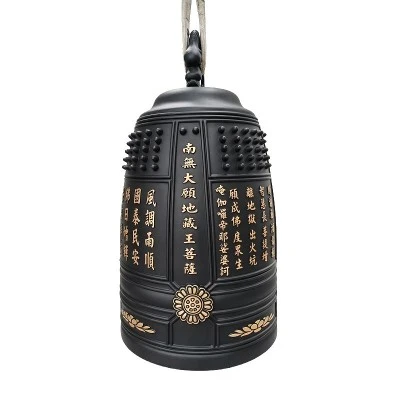
As significant percussion instruments and ritual vessels in ancient China, bronze bells played a role across diverse spheres, including ritual music, religion, court life, and cultural symbolism. Within the system of rites and music established during the Western Zhou Dynasty, *bianzhong* (chime bells) became the primary instruments for solemn court music; as supreme ritual artifacts symbolizing rank and authority, they were employed during major state occasions such as sacrificial ceremonies, banquets, diplomatic receptions, and military campaigns. In the religious realm, following the introduction of Buddhism, large bronze bells became indispensable ritual implements in monasteries, used for marking time, summoning the assembly, and conducting religious ceremonies; Taoism likewise utilized its own forms of bells.
In the context of court and daily life, specific bells were used for imperial processions, while others served in city bell towers to announce the time. Notably, the sound of the Tang Dynasty's Jingyun Bell has been broadcast as the New Year's chime during the Spring Festival Gala since the 1980s. Furthermore, bronze bells carry cultural symbolic significance; the phrase "bells ringing and cauldrons of food" epitomizes the lifestyle of the aristocracy, and the bell itself has become a symbol of power (such as the massive bells cast by Qin Shi Huang) and culture (such as the "Golden Bell Award").
In modern times, replicas of ancient chime bells-such as those of Marquis Yi of Zeng-are used in international cultural exchange activities to promote China's fine traditional culture.
